'This is not traditional food': How the chef at Vancouver's leading Cambodian restaurant finds his own path
'Top Chef' winner Chanthy Yen's knowledge of his own culinary background doesn't mean recreating a roadside stall in Phnom Penh.
For chef Chanthy Yen, Cambodian food has never simply been a cuisine. It's memory, family, history and responsibility.
Increasingly, it's also become a way of creating space for a culture that he believes has spent far too long outside the global culinary conversation.
“I want to also carve the way for other Cambodians to finally be proud of their cuisine,” Yen tells me.
That is a considerable weight to carry, particularly when the cuisine itself remains unfamiliar to many diners. Thai and Vietnamese restaurants have long been part of the North American dining landscape. Cambodian food, despite sharing geography and some ingredients with its neighbours, has never received the same international recognition.
Yen believes history is inseparable from understanding why.
Cambodia was once the centre of the vast Khmer Empire, which at its height stretched across much of mainland Southeast Asia. Centuries later came French colonial rule, civil war and the Khmer Rouge regime, which between 1975 and 1979 killed nearly two million people and attempted to dismantle traditional Cambodian society.
Food traditions were inevitably caught in that destruction. Famine, displacement and genocide disrupted generations of knowledge, yet foods including fermented rice noodles, prahok, kroeung and bobor remained part of the country's culinary identity.
“Cambodian cuisine is ancient,” Yen says.
Chef Chanthy Yen's kitchen experience began in immigrant household in Ontario
Yen grew up in Ontario in a Cambodian immigrant household and spent much of his early childhood with his grandmother. The kitchen was simply part of everyday life.
“I'd be in the garden, chopping the chickens, doing all of that work,” he recalls.
Food was how his grandmother cared for the family and how Yen began building his palate.
In his 20s, Yen's career took him to Spain, where he worked with acclaimed Basque chef Andoni Luis Aduriz at Mugaritz before being personally selected by Ferran Adria, regarded by many as one of the world's greatest chefs, to join his research team at the elBulli Foundation in Barcelona.
His career later brought him back to Canada, where he became personal chef to former prime minister Justin Trudeau and eventually won Season 11 of Top Chef Canada.
But after years spent learning and cooking through other culinary traditions, Yen found himself looking more deeply at his own.
“Going inside myself is the biggest challenge,” Yen says. “You don't know what you may find in there.”
Touk goes beyond boundaries of tradition
At Touk, that exploration doesn't mean recreating a roadside restaurant in Phnom Penh. “This is not traditional food,” he says plainly.
Instead, Yen uses B.C. ingredients to express Cambodian ideas. Kampot peppercorns and rice come from Cambodia, while others might come from Thailand, Vietnam or closer to home.
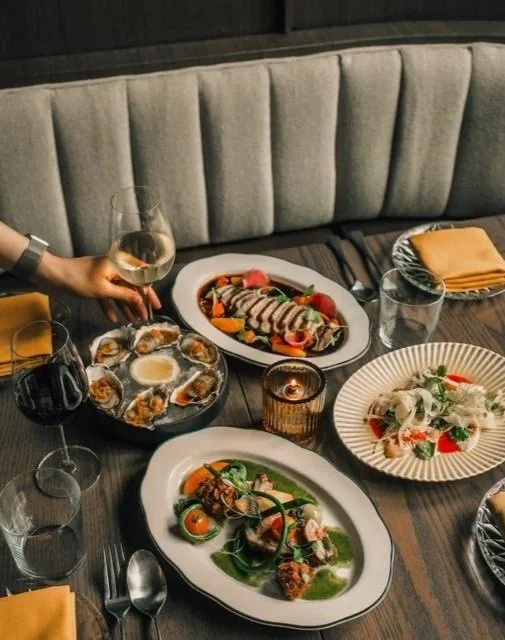
Then there's the restaurant's fermentation work. Scallop garum is made in-house using Hokkaido scallops, while the kitchen makes its oyster sauce from scratch using fresh oysters.
“Our oyster sauce is from fresh oysters, salted inside and purified,” Yen says.
That fermentation and funk, so familiar across Southeast Asian cooking, is part of the balance found throughout the food at Touk. Sweetness from fruit is often cut with plenty of acid, whether from citrus, tamarind or something pickled.
The sablefish is a good example of that approach. “In Cambodia, when you are on the roadside, you see a lot of grills,” Yen says.
Inspired by grilled fish commonly eaten with mango salad, Yen prepares the sablefish fried and grilled over charcoal, served with burnt mango purée and pickled green mango.
Some dishes, though, carry more history and emotion.
One particularly meaningful to Yen is bobor, Cambodia's rice porridge. At Touk, the comforting congee is built around local seafood, including spot prawns and squid, bringing something deeply rooted in Cambodian food together with ingredients from the coast here.
“It is a healing dish,” he says. “If you're feeling under the weather or unloved, it's a dish that gives you a little bit of a hug in a bowl.”
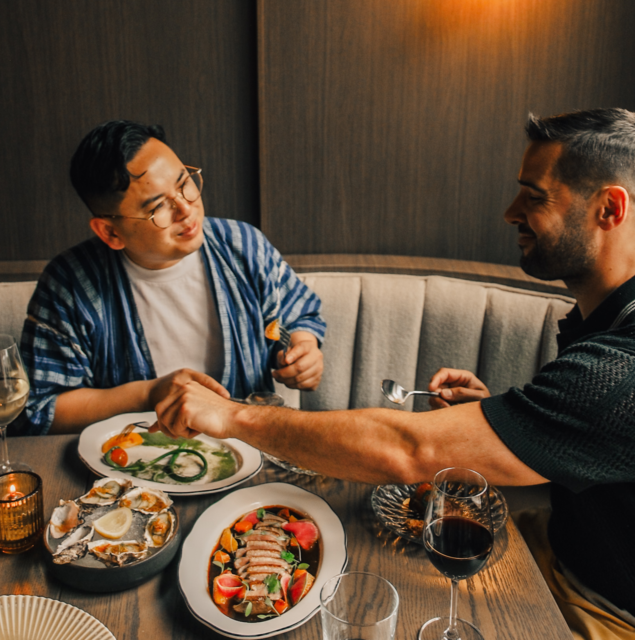
That sense of journey extends into the restaurant itself. Touk means “boat” in Khmer, a name Yen has described as a way of taking guests through Cambodian cuisine. He wanted the room to feel warm and textural, creating a sense of anticipation as you enter.
Creating a round table for Cambodian chefs
For Yen, the larger ambition extends beyond one restaurant. He talks about creating a kind of round table for Cambodian chefs, making enough room that others can eventually step forward with their own perspectives.
“I can handle the critiques,” he says. “I can handle the pressure. I can hold onto that just to make space for more people.”
For all the technique, travel and accolades behind him, Yen calls food his love language. Growing up introverted, cooking was how he communicated, whether feeding friends, preparing family meals or bringing food to community events.
Today, the room is considerably larger.
Yen says some guests visiting from Cambodia have cried during meals at Touk, seeing their country and its cuisine celebrated in a way they hadn't experienced before. He hopes people arrive knowing little about Cambodian food and leave wanting to know more, curious enough to continue the journey.
After recently experiencing Yen’s food for the first time, I can certainly count myself among them.